目次
- The tell that makes a faceless video sound cheap
- What Premium Voice actually does
- One line, two readings
- Why the voice decides whether anyone stays
- Not every format needs it equally
- Writing scripts that give the voice something to work with
- What you get, and what it costs
- How to turn on Premium Voice
- Putting it into action
A faceless video survives a plain thumbnail. It survives a scene that lingers half a beat too long. What it rarely survives is a narrator who sounds like a machine working through a paragraph. The words are right, the delivery is dead, and viewers tend to leave before the first scene is over.
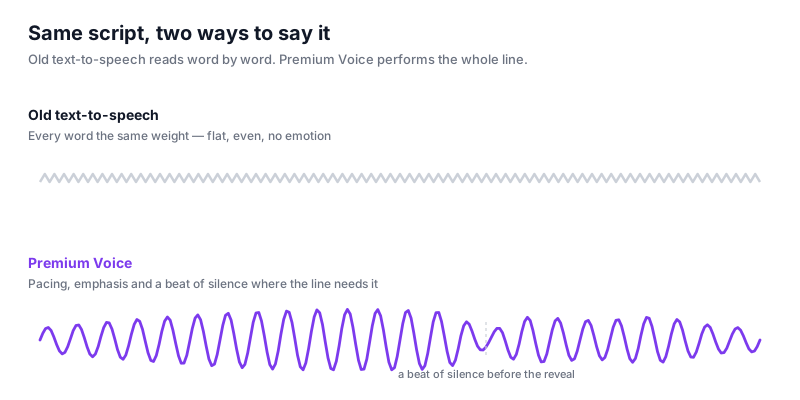
That flat, mechanical read has a name: text-to-speech. For years it was the only option if you did not want to record yourself, so a whole category of faceless content grew up sounding identical — evenly paced, emotionless, obviously not a person. Premium Voice is our answer to that, and it is a genuinely different technology. It does not read your script. It performs it.
The tell that makes a faceless video sound cheap
Old text-to-speech works one word at a time. It converts symbols to sound with no idea what the sentence means, where the tension sits, or which word carries the point. So every line lands with the same weight — a throwaway aside and the twist you built the whole video around are read in exactly the same tone. Most people cannot articulate what is wrong, but they hear it within a sentence or two, and the video gets filed under "AI, skip."
The irony is that the story underneath might be genuinely good. The script can be tight, the hook real, the pacing smart. But narration is the layer a viewer experiences first and then continuously, so a robotic read quietly undersells everything behind it. For a lot of faceless channels, the voice is the weakest link nobody thinks to fix.
What Premium Voice actually does
Premium Voice runs on a speech-synthesis large model, and the architecture matters more than the label. It is built on large-language-model foundations, which is what lets it do the thing older engines could not: understand the script rather than transcribe it. The people who build these models describe the shift as moving beyond plain text reading toward precise emotional expression that follows from understanding — from merely being intelligible to grasping meaning and context.
In practice that means the model reads for subtext. It picks up the emotional thread running under the words — the background a line implies, the mood carried over from the previous sentence — and it tracks how that feeling develops across a script instead of treating each sentence as an isolated job. Then it delivers with tone, intonation and pauses matched to the moment. So a reveal gets the beat of silence before it lands, a tense passage tightens, and a warm line actually sounds warm.
The audible result is the stuff a real narrator brings and old synthesis never could: natural pacing, prosody, the small breaths between clauses, emotion that shifts as the story shifts. It sounds like someone who understood the sentence before they said it.
Practically, you are not picking a voice from a menu and hoping it suits the script. You switch Premium Voice on, and the engine directs the performance to your story.
One line, two readings
Abstract claims about "expressiveness" are easy to make and hard to hear. So take a single sentence — the kind that ends a scene in a creepy-story video:
Nobody noticed the door was open.
Old text-to-speech gives every word in that sentence the same size. "Nobody," "noticed," "door" and "open" all get identical weight and identical spacing, because the engine has no idea which of them is the point. The sentence is intelligible and completely inert. You have delivered a reveal with the cadence of a weather report.
Read it the way a person would and three things happen that no amount of word-choice can substitute for. "Door" gets the emphasis, because that is the object the horror hangs on. A beat of silence opens up just before it, which is what makes a listener lean in. And "open" falls slower and lower at the end, so the sentence settles instead of just stopping.
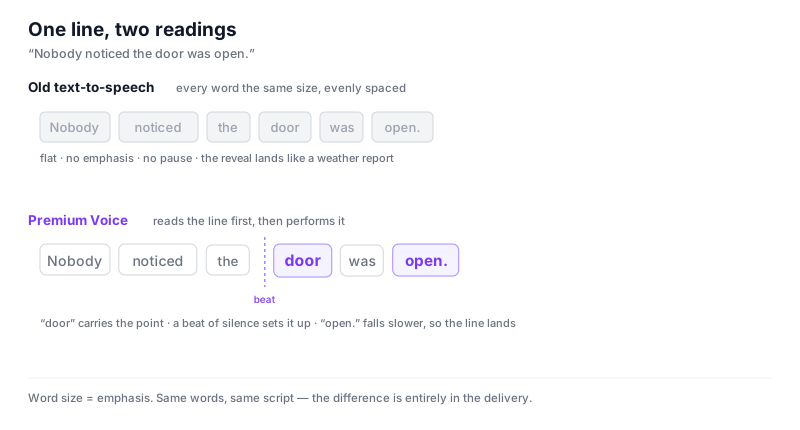
Same words. Same script. Every bit of the difference is in the delivery — and that difference is the entire distance between a video that feels made and one that feels generated.
Why the voice decides whether anyone stays
What holds someone on a short video is rarely a single image. It is momentum, and narration is the thread that carries it from one scene to the next. That momentum lives in exactly the mechanics above: the rise before a twist, the pause that lets a fact land, the tonal shift that signals the mood has changed. Read everything at one pitch and those signals disappear, along with most of the reason to keep watching.
This is also where the "AI slop" reputation comes from. Audiences are perfectly happy to watch beautifully generated images — the visuals are seldom the complaint. What gives a video away is a voice announcing in its first sentence that nobody really made this. Expressive narration removes that tell, and the video starts feeling authored instead of mass-produced.
If you run a series, the effect compounds. A narrator who sounds like a person becomes part of your channel's identity, which is hard to build when every episode opens like a station announcement.
Not every format needs it equally
Voice matters everywhere, but it does not matter equally everywhere, and knowing the difference tells you where to spend your attention. The rough rule: the more of a format's effect comes from delivery rather than raw information, the more the narration decides whether it works.
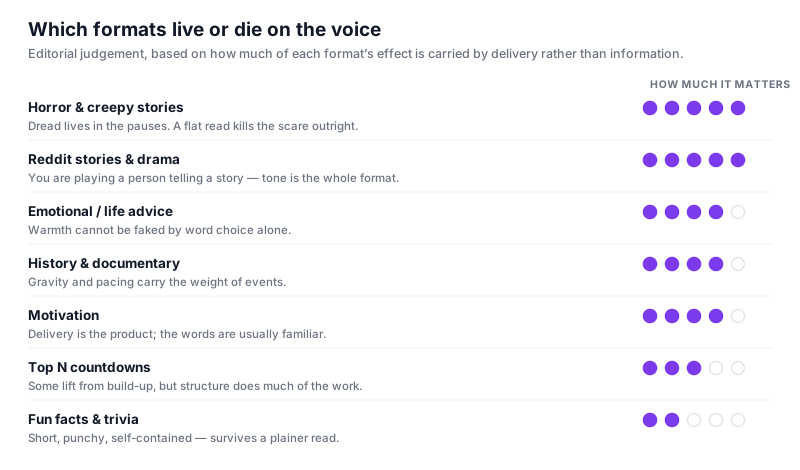
Horror and creepy stories sit at the top because dread is manufactured almost entirely in the pauses — a flat read does not weaken the scare, it cancels it. Reddit stories and drama are close behind, since the format is fundamentally an impersonation: you are playing a person recounting something that happened to them, and tone is the format. Emotional and advice content needs warmth that word choice alone cannot fake, and history needs the gravity that pacing provides.
At the other end, fun facts and trivia survive a plainer read. They are short, self-contained, and the surprise is carried by the information itself. Top N countdowns fall in between: build-up helps, but the structure does a lot of the work on its own.
None of this means "only turn it on for horror." It means that if you run a story-driven channel, the voice is not one improvement among many — it is the thing your format rests on.
Writing scripts that give the voice something to work with
Once narration understands context, the way you write starts to matter differently. A few habits worth adopting:
Let sentence structure carry the emotion, not punctuation. Writers used to flat engines learn to compensate with exclamation marks and capitals, because that was the only lever available. An engine reading for meaning does not need the shouting, and stacked exclamation marks tend to push it toward a uniform excitement that flattens the very variation you want.
Put the important word at the end of the sentence. "Nobody noticed the door was open" works because the reveal lands last. Rewrite it as "The door was open and nobody noticed" and you have handed the engine a sentence that trails off after its own climax. This is good writing advice regardless, but it pays double when something is actually performing the line.
Leave room for the pause instead of writing it in. You do not need to insert "…" everywhere. Give the reveal its own short sentence and the beat appears naturally, because the model is tracking where the tension sits.
Let the mood shift on the page. The engine follows emotion as it develops across a script rather than resetting each sentence. If your script moves from unsettling to calm, write that turn plainly — the delivery will follow the arc you wrote.
What you get, and what it costs
A few things worth knowing:
- It is included. Premium Voice is a membership benefit with no extra quota — turning it on does not cost you more generations than a standard voice. Use it on every episode if you want to.
- 17 languages. Premium Voice speaks English, Chinese, Japanese, Korean, Spanish, Portuguese, French, German, Russian, Italian, Vietnamese, Thai, Turkish, Polish, Malay, Dutch and Filipino. If you work in a language it does not yet cover, your video still generates on a standard voice — nothing breaks.
- You are never locked in. Premium Voice does not hide the standard voice list. Prefer a specific standard voice for a particular series? Switch back anytime; the choice is per video.
How to turn on Premium Voice
You will find it in two places, and both take one click:
- When you create a video: on the Voice step of the wizard, Premium Voice sits at the top of the list as the recommended option. Select it and generate.
- When you edit an episode: open the narrator voice section and pick the Premium Voice card. Changes batch up, so make your edits and hit re-render once to apply them together.
That is the whole setup. There is nothing to configure — the engine handles the direction.
Putting it into action
One thing worth taking from this: the voice is not a finishing touch, it is the first thing an audience judges you on. Before you rework another thumbnail or rewrite another hook, play your last few videos with your eyes closed. If the narration sounds like a machine reading, that is the highest-return fix available to you, and it now takes one switch. Turn on Premium Voice, generate the next episode, and listen to the first sentence.
よくある質問
How is Premium Voice different from a standard voice?
A standard voice is one you pick from a list, and it delivers every script the same way. Premium Voice runs on a speech-synthesis large model built on large-language-model foundations, so it reads for meaning and context first — picking up the emotional thread under the words and how it develops — then performs the line with matching tone, intonation and pauses.
Does Premium Voice cost extra?
No. Premium Voice is a membership benefit with no extra quota — using it does not consume more generations than a standard voice. You can use it on every episode.
Which languages does Premium Voice support?
Seventeen: English, Chinese, Japanese, Korean, Spanish, Portuguese, French, German, Russian, Italian, Vietnamese, Thai, Turkish, Polish, Malay, Dutch and Filipino. In a language it does not yet cover, your video still generates on a standard voice.
Can I switch back to a standard voice?
Anytime. Premium Voice does not lock the standard voice list — the choice is made per video, so you can prefer a specific standard voice for one series and Premium Voice for another.
ひとつのテーマから顔出しなしのシリーズ動画を
Fableclip が脚本・ナレーション・イラスト・字幕をすべて自動で仕上げ、各エピソードを TikTok、YouTube、Instagram に自動投稿します。最初の動画は無料の動画枠で作成できます。
無料でシリーズを始める →