目次
- How to read the rankings
- The best faceless YouTube niches at a glance
- 1. Psychology & curiosity
- 2. Personal finance
- 3. History & documentary
- 4. Space & science facts
- 5. AI & tech explainers
- 6. Scary stories & horror narration
- 7. Health & wellness
- 8. Motivation
- 9. Reddit stories
- 10. Luxury & wealth
- 11. Kids' educational
- 12. True crime
- Which faceless YouTube niche should you actually pick?
- Putting it into action
Every list of faceless YouTube niches leads with the same promise: pick finance, earn $25 RPM, retire. Then you open the channels actually doing it and find a graveyard — thousands of AI-voiced finance channels with 200 views a video, all following the same advice.
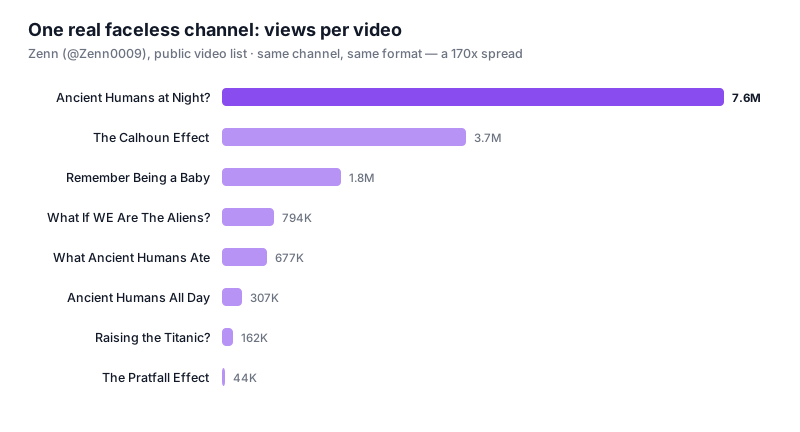
Here is what those lists skip: the niche you pick matters less than whether you can keep producing it after the motivation wears off. Faceless channels are a portfolio game. When we pulled apart a real faceless channel earning 7.6M views in our teardown, the spread between its best and worst video was 170x — most uploads sat in the five figures while two hits carried the channel. You do not survive that math with three videos and a dream. You survive it with a niche you can ship weekly for a year.
So this list is ranked differently. Not by RPM alone — by AI-production fit: how well the niche holds up when a solo creator produces it with AI visuals, AI voiceover, and a fixed schedule, times the realistic money. For every niche you get the honest RPM range, the catch nobody mentions, two or three concrete faceless YouTube channel ideas, and a series blueprint you can copy into whatever tool you use to produce episodes.
How to read the rankings
Three rules before the list.
RPM ranges are ranges — and here is where they come from. RPM is YouTube's own metric for total revenue per 1,000 views, after YouTube's cut. YouTube publishes no official RPM-by-niche table — any list quoting exact niche figures without sources is guessing. The ranges below are our editorial estimates, anchored to creators' public self-disclosures, which you can check yourself. Ali Abdaal, for example, disclosed that his "9 Passive Income Ideas" video earned $191,258 on roughly 9.8M views — about $19.5 per thousand views, inside the finance band below — and monetized creators post real RPM screenshots in r/PartneredYoutube every week. Creators consistently report that non-US/UK audiences monetize 30–50% lower. Treat every figure as a planning input, not a promise — your niche choice sets the ceiling, but packaging and consistency decide where under that ceiling you actually land.
Saturation is not a reason to skip a niche. It is a reason to enter with an angle. Every niche below has crowded generic territory and open specific territory — the channel ideas show the difference.
A blueprint beats a mood board. Each niche ends with a series blueprint: format, episode length, cadence, and hook pattern. That is deliberately the exact set of decisions you lock in once and repeat — our teardown of that channel showed the winning channels decide these once and never improvise them per video.
The best faceless YouTube niches at a glance
| # | Niche | RPM (US) | Competition | AI-fit |
|---|---|---|---|---|
| 1 | Psychology & curiosity | $8–14 | Medium | Excellent |
| 2 | Personal finance | $15–25 | Very high | Good |
| 3 | History & documentary | $6–12 | Medium | Excellent |
| 4 | Space & science facts | $6–12 | Medium | Excellent |
| 5 | AI & tech explainers | $8–15 | High | Good |
| 6 | Scary stories & horror | $4–8 | Medium | Excellent |
| 7 | Health & wellness | $10–18 | High | Fair |
| 8 | Motivation | $8–12 | Very high | Good |
| 9 | Reddit stories | $4–8 | High | Excellent |
| 10 | Luxury & wealth | $12–18 | Medium | Good |
| 11 | Kids' educational | $3–7 | Medium | Good |
| 12 | True crime | $6–12 | High | Fair |
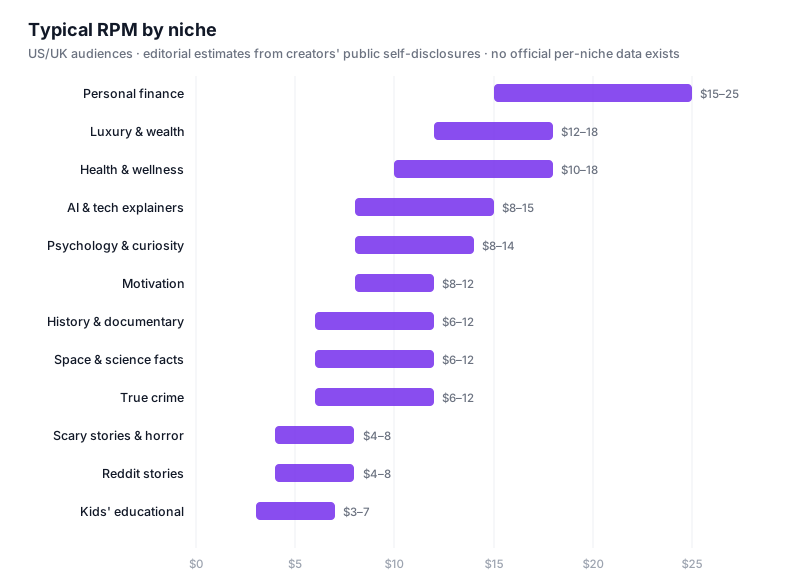
Methodology: RPM figures for the faceless YouTube niches above are editorial estimates for US/UK audiences, anchored to creators' public self-disclosures — sources and a worked example in "How to read the rankings" above. Expect wide variance by audience geography, season, and channel maturity.
1. Psychology & curiosity
This is the niche behind the channel we tore down — videos like Why You Can't Remember Being a Baby and The Calhoun Effect, doodle animation over an AI-adjacent voice, zero faces. It ranks first here for a simple reason: it is the rare niche where the question is the thumbnail. Human-behavior questions have built-in curiosity gaps, so packaging — the thing that actually decides faceless channel outcomes — comes almost free.
The catch: substance. The channels that win in this niche compress real studies and real history into scripts; the ones that die paraphrase Wikipedia's first paragraph for eight minutes. Budget research time per episode or skip this niche.
Channel ideas: a series answering "why do humans do X" with one study per episode; a series on famous psychology experiments and what they got wrong; a series on cognitive biases shown through everyday scenarios.
Series blueprint — Format: one question per episode, answered in 6–8 minutes. Hook: state the question, then the least believable true fact about it, inside fifteen seconds. Cadence: 2 episodes/week. Visual style: consistent flat illustration — same palette every episode so the feed looks like one show.
2. Personal finance
The highest advertiser demand on YouTube, which is exactly why every list leads with it and exactly why the generic middle is a graveyard. "How to budget" and "what is compound interest" are owned by established channels with years of authority. The $15–25 RPM is real; your odds of collecting it with generic content are not.
The way in is specificity. Finance for one audience, one life stage, one country's system. The narrower the promise, the weaker the incumbent competition, and the advertiser demand follows you down the long tail.
Channel ideas: money mistakes by decade of life, one decade per episode arc; how specific famous fortunes were actually built and lost; a "reading the fine print" series that walks through one real contract type per episode.
Series blueprint — Format: one financial trap or story per episode, 8–10 minutes. Hook: open with the dollar amount lost or gained, then rewind. Cadence: weekly — research depth beats frequency here. Visual style: motion-graphic numbers and documents, not stock footage of people.
3. History & documentary
The internet's appetite for "what did ancient people actually do" is effectively bottomless — the 7.6M-view video in our teardown was exactly this. History rewards faceless production because the visuals should not be a person talking: maps, timelines, reconstructions, and illustrated scenes are the native format, and AI image generation handles all of them.
The catch is that generic "top 10 ancient facts" is saturated. The winning pattern is a consistent lens: everyday life, food, night, money, punishment — one angle applied across eras, so every episode markets the next one.
Channel ideas: daily life in one ancient city per episode; the history of one everyday object per episode; "the last day of" famous places and people.
Series blueprint — Format: one place/object/day per episode, 8–12 minutes. Hook: a concrete sensory detail first ("the streets smelled of bread and sewage"), thesis second. Cadence: weekly. Visual style: illustrated scenes in one consistent art style — era changes, palette does not.
4. Space & science facts
Space is the most forgiving faceless YouTube niche on this list for a beginner. The subject matter supplies its own spectacle, the audience is broad, mistakes are survivable, and stock-adjacent AI visuals of nebulae and planets are indistinguishable from expensive licensed footage. RPM is mid-range, but watch time runs long — space viewers binge.
The catch: accuracy debt. Science audiences correct you in the comments, and repeated corrections kill channel trust. Stay one step behind the frontier — explain settled science well rather than racing preprint news.
Channel ideas: "what would actually happen if" physics scenarios; one solved scientific mystery per episode; scale comparisons — sizes, distances, timescales — as a visual series.
Series blueprint — Format: one scenario or mystery per episode, 6–10 minutes. Hook: the scenario stated as a dare ("suppose you fell into Jupiter"). Cadence: 2 episodes/week. Visual style: dark backgrounds, high-contrast renders — thumbnails read at feed size.
5. AI & tech explainers
High advertiser demand, endless material, and an audience that already accepts AI-made content — this niche would rank higher if it weren't aging so fast. Tech explainers date in months; evergreen library value is low, so you are on a treadmill of relevance. That is fine if you enjoy the subject and fatal if you don't.
The way to slow the treadmill: explain patterns, not products. "How recommendation algorithms decide what you see" outlives any individual app news cycle.
Channel ideas: how everyday systems actually work under the hood; one tech failure story per episode; plain-English explainers of the tech behind current headlines.
Series blueprint — Format: one system explained per episode, 6–8 minutes. Hook: start from the user's daily experience, then open the black box. Cadence: 2 episodes/week while topics are hot. Visual style: clean diagram animation; avoid screen recordings that date the video.
6. Scary stories & horror narration
Horror is the most format-native faceless YouTube niche in existence — the genre wants darkness, stillness, and a disembodied voice. Production cost is the lowest on this list: a strong script, a slow-burn voiceover, and a handful of atmospheric visuals per episode. RPM is modest, but completion rates and binge behavior are exceptional, and the algorithm pays for both.
The catch: originality. Reading other people's creepypasta invites strikes and blends you into a thousand identical channels. Original stories — or public-domain and properly licensed material — are the moat.
Channel ideas: original rule-based horror ("follow these rules at the night shift"); one cursed-object story per episode; local legends retold with maps and dates.
Series blueprint — Format: one self-contained story per episode, 10–15 minutes. Hook: establish the rule or the wrongness in the first line — no throat-clearing. Cadence: weekly, published at night in your audience's timezone. Visual style: 4–6 dark stills per episode, slow zooms, no jump-scare spam.
7. Health & wellness
Strong RPM and permanent demand, ranked mid-list because trust is the product, and faceless channels start with a trust deficit. YouTube also applies stricter standards to health content, so cutting corners on accuracy is a channel-level risk, not a video-level one — a single flagged claim can suppress the whole library, not just the offending video.
The survivable versions avoid diagnosis and treatment entirely: sleep, habits, posture, food history, "what happens to your body when" mechanism explainers sourced from mainstream consensus. Stay descriptive rather than prescriptive — explain what the body does, never what the viewer should do about it — and this niche's RPM becomes collectible instead of theoretical.
Channel ideas: "what happens to your body when" mechanism series; the science of everyday habits; food myths traced to their historical origin.
Series blueprint — Format: one mechanism or myth per episode, 6–8 minutes. Hook: the counterintuitive consensus finding first. Cadence: weekly. Visual style: anatomical illustration, consistent and non-graphic — thumbnails must pass advertiser review.
8. Motivation
The most saturated niche on this list, kept here because the distribution economics still work. Motivation clips travel across Shorts, Reels, and TikTok almost unedited, so one production run feeds four platforms. As pure YouTube long-form it is nearly unwinnable now; as a multi-platform clip engine it still works.
The catch is differentiation. Stock waves crashing over a Goggins quote is a dead template. The living versions pair motivation with a concrete container — money, sport, craft, recovery — and real stories.
Channel ideas: one real comeback story per episode, told with dates and numbers; stoic ideas applied to one modern situation per episode; training-philosophy breakdowns from named disciplines.
Series blueprint — Format: one story or idea per episode, 3–5 minutes long-form plus a 45-second cut for Shorts. Hook: start at the lowest point of the story. Cadence: 3 short episodes/week — volume matters in clip niches. Visual style: consistent typographic treatment; own a look, not a stock library.
9. Reddit stories
The assembly line of faceless content: infinite raw material, proven formats, and an audience that watches on second screens for hours. AI production fit is excellent because the format is pure narration. But treat the RPM honestly — story content monetizes at the low end, and the niche lives on volume.
The legal and ethical catch: read the room and the license. Verbatim scraping of identifiable posts is both a copyright gray zone and a reputation risk. The durable channels rewrite, anonymize, and curate — editorial judgment is the actual product.
Channel ideas: one moral-dilemma story per episode with a verdict poll; workplace stories by industry; "updates" compilations that follow stories over time.
Series blueprint — Format: 2–3 curated stories per episode, 10–15 minutes. Hook: the dilemma stated in one sentence before the intro. Cadence: 3 episodes/week — this niche rewards volume. Visual style: minimal — subtle background loop plus clean captions; the voice carries it.
10. Luxury & wealth
The quiet performer: mid-to-high RPM, moderate competition, and endlessly renderable subject matter — yachts, watches, architecture, private aviation. Advertisers targeting high-intent consumers pay well, and the visuals are exactly what AI image and video generation are best at.
The catch: this niche quietly demands an editorial spine. "Inside a $50M mansion" with recycled footage is saturated; the versions that retain viewers are analytical — why things cost what they cost, who actually buys them, what the economics look like underneath the gloss.
Channel ideas: the real cost-of-ownership of luxury assets, one asset per episode; how luxury brands actually make money; "what $X buys you" across countries and eras.
Series blueprint — Format: one asset or brand per episode, 8–10 minutes. Hook: the number first, the explanation second. Cadence: weekly. Visual style: high-gloss renders with consistent grading — the feed should look like a magazine.
11. Kids' educational
Steady demand, low RPM, and a structural advantage nobody mentions: kids rewatch. A library of counting songs, animal facts, and bedtime stories compounds view hours long after publication in a way adult content never does. Animated formats are fully AI-producible.
The catch is regulatory and platform-mechanical: made-for-kids content has limited data collection, limited ads, and comments off — which is why RPM is low — and quality bars for children's content are rising. This niche is a long-game library play, not a quick monetization play.
Channel ideas: one animal fact story per episode with a recurring guide character; counting and alphabet adventures; gentle bedtime stories with consistent characters.
Series blueprint — Format: one story per episode, 4–7 minutes. Hook: name the character and the problem in the first sentence — kids decide instantly. Cadence: weekly, absolute consistency in style and characters. Visual style: soft palette, recurring cast, zero visual surprises.
12. True crime
Enormous audience appetite and strong watch time, ranked last on purpose. The niche demands the most research per episode on this list — real names, real victims, real legal exposure — and both platform policy and audience norms have tightened on low-effort AI true crime. Done carelessly, it is a strike magnet; done properly, the research cost erases the automation advantage.
If you want the narrative appetite without the exposure, historical cases — decades old, well-documented, out of living memory — are the defensible corner.
Channel ideas: solved historical cases explained through the evidence; famous forgeries and frauds; disappearances with documented resolutions.
Series blueprint — Format: one closed case per episode, 12–15 minutes. Hook: the moment the case broke open, then rewind to the start. Cadence: weekly at most — research is the bottleneck. Visual style: documents, maps, dates; restraint reads as credibility here.
Which faceless YouTube niche should you actually pick?
Ignore RPM for a second and answer three questions. They matter more than any ranking on this page, because they are about you, not the market — and in a portfolio game, the producer who keeps showing up is the variable that decides everything.
Can you ship this niche on a bad week? The portfolio math from our channel teardown is unforgiving: most uploads land in the modest middle, and the hits arrive on their own schedule. The niche you can produce on autopilot beats the niche you love producing occasionally.
Does the niche have a repeatable question? Every strong series above reduces to a template — "why do humans…", "what did ancient…", "what happens if…". If you cannot write ten episode titles in ten minutes, you have a video idea, not a channel idea.
Is your angle specific enough to be someone's favorite channel? Generic finance loses to finance-for-nurses. Generic horror loses to rule-based night-shift horror. The narrow version feels smaller and wins bigger.
Putting it into action
Every blueprint above is four decisions: format, length, cadence, hook. That is not an accident — those are exactly the decisions that separate channels that publish for a year from channels that die at video seven. Lock them once, then let the production run. The failure mode to avoid is re-deciding everything per video: new style, new length, new posting day. Every re-decision is a chance to stall, and stalling — not niche choice — is what actually kills most faceless channels.
That is the workflow fableclip was built around: you set the topic, format, art style, voice, and schedule once as a series, and it produces episodes on autopilot — script, visuals, voiceover, and captions in one pass. Pick a faceless YouTube niche from this list, copy its blueprint into a new series, and your first episode is a render away, not a production week away.
よくある質問
What is the best faceless YouTube niche for beginners?
Space & science facts and history are the most forgiving: broad audiences, visuals that AI generation handles natively, and mistakes that don't carry the trust or policy risk of health, finance, or true crime. Psychology & curiosity pays better but demands real research per episode.
What is the most profitable faceless YouTube niche in 2026?
By creator-reported figures, personal finance leads on RPM ($15–25 for US audiences), with luxury ($12–18) and health ($10–18) behind it. But realized profit depends on actually getting views in a very saturated field — a mid-RPM niche you can produce consistently usually out-earns a high-RPM niche you abandon.
Are faceless YouTube channels still worth starting in 2026?
Yes, with honest expectations. Faceless channels are a portfolio game: in the real channel we analyzed, the spread between the best and worst video was 170x, with most uploads in the five figures. The channels that win publish consistently for months and let the hits arrive on their own schedule.
How often should a faceless channel post?
The blueprints in this list range from one to three episodes per week by niche. Story and clip niches (Reddit stories, motivation) reward volume; research-heavy niches (finance, true crime) reward depth at weekly cadence. Whatever you choose, a schedule you can hold for six months beats a sprint you can hold for three weeks.
Can you run a faceless channel entirely with AI?
Production, yes — script drafting, visuals, voiceover, and captions are all automatable, which is exactly what fableclip does as a single pipeline. Judgment, no: niche selection, episode angles, and quality control on scripts still decide outcomes. AI removes the production bottleneck; it doesn't remove the need to be interesting.
ひとつのテーマから顔出しなしのシリーズ動画を
Fableclip が脚本・ナレーション・イラスト・字幕をすべて自動で仕上げ、各エピソードを TikTok、YouTube、Instagram に自動投稿します。最初の動画は無料の動画枠で作成できます。
無料でシリーズを始める →